


Public Animal Sales
and Transfer Ordinance
Creating safer communities for people and animals
Across Tennessee, animals are routinely sold, transferred, and given away in parking lots, flea markets, roadside locations, and other public spaces with little oversight or accountability. While many transactions may be well-intentioned, these environments can create challenges related to consumer protection, animal welfare, public safety, and community resources.

Columbia parking lot puppy sales in February 2026
We're working with communities across Tennessee to explore practical, locally driven solutions that encourage responsible pet ownership and improving accountability in animal transactions – each of which help address the broader impacts of animal overpopulation.
Jump to: Why this matters | The initiative | FAQs | Local progress | How we'll help | Bring to your community
Why this matters
Animal overpopulation affects every community, regardless of whether it operates a shelter. When animals are bred and distributed through unregulated channels, communities often experience the consequences through increased stray populations, animal abandonment, consumer complaints, public safety concerns, and greater demand on local resources and animal welfare services.
Communities without shelters are not immune. When neighboring shelters reach capacity, unwanted animals are often abandoned, surrendered through informal channels, or displaced into areas with fewer resources available to address the problem.
Because Tennessee currently lacks statewide regulations governing commercial breeding and many forms of public animal sales, local governments often play an important role in establishing reasonable safeguards that reflect the needs and priorities of their communities.
What's the initiative?
The Public Animal Sales and Transfers Initiative encourages municipalities to consider ordinances that regulate the sale, transfer, display, and giveaway of animals in public spaces, including:
-
Parking lots
-
Roadsides
-
Flea markets
-
Outdoor markets
-
Other transient sales environments
The initiative also encourages communities to evaluate whether retail sales of dogs, cats, and rabbits align with their local animal welfare and community goals. These ordinances are designed to support responsible pet ownership while promoting transparency, accountability, and consumer protection.
Frequently Asked Questions
We understand that community members may have questions about how this initiative could affect responsible breeders, pet owners, rescue organizations, local businesses, and animal welfare efforts. Our FAQ document provides answers to common questions and explains how the proposed approach is intended to promote accountability, consumer protection, public safety, and responsible animal ownership.
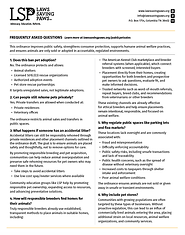
Click to download the FAQs sheet
The ordinance does:
Promote public safety
Strengthen consumer
protection
Improve accountability in animal transactions
Promote responsible breeding practices
Support humane animal welfare standards
Reduce strain on local resources
The ordinance doesn't:
Ban pet ownership
Ban responsible breeding
Prohibit private pet rehoming
Restrict shelter/rescue adoption events
Restrict pet stores from selling supplies
Local progress
Currently we're working to implement this ordinance in Mount Pleasant.
We've already worked with local leaders in Columbia to explore this approach and in 2026, the Columbia City Council adopted an ordinance prohibiting the sale or giveaway of domestic animals in public spaces, helping establish clearer standards for animal transactions within the community.
The ordinance was developed through collaboration with local stakeholders and city officials and serves as one example of how communities can work together to support the wellbeing of their community's people and pets.

Left to right: LSP President, Meaghan Thiede, Columbia City Council Member, Brian McKelvy, and LSP Vice President, Candy Listz
How we'll help
Exploring new community initiatives can feel overwhelming, especially when local leaders are balancing competing priorities and limited resources. That's why we're committed to being more than a source of information... we also strive to be a collaborative partner throughout the process. Communities interested in learning more about this initiative will receive support tailored to their specific needs, including:
-
Educational resources
-
Sample ordinance language and implementation guidance
-
Community outreach and engagement support
-
Participation in public meetings, workshops, and local events
-
Assistance addressing questions and concerns from residents and local leaders
-
A custom webpage for your community, including an online petition and engagement tools
Whether a municipality is simply exploring the issue or actively considering policy changes, we're committed to serving as a resource throughout the process... not just at the beginning.
Interested in bringing this to your community?
We recognize that every community is unique. Our goal is not to promote a one-size-fits-all solution, but to serve as a resource for local leaders interested in exploring practical approaches to animal welfare, consumer protection, and community wellbeing. We'll help provide:
-
Sample ordinance language
-
Research and supporting resources
-
Educational materials
-
Background information on community impacts
-
Guidance based on our experience working with local governments
The complete ordinance packet, including supporting research, model ordinance language, and implementation considerations, is available upon request.
Ready to learn more? Contact us to discuss opportunities in your community.

Stay up-to-date
Subscribe to our newsletter to stay updated on the progress of this campaign, among other important events happening around us.